Painted Stone Settlers School Day Program
Friday, September 11, 2026
9 am – 1 pm
Red Orchard Park, Shelbyville
Welcome to the Painted Stone Settlers’ School Day Program! We hope you will enjoy our program as much as we enjoy bringing it to you.
Note: We will instruct all groups to combine around 11:00 – 11:30 am (approximately) for a group presentation at the bleacher site. A program introduction will be given at this time to familiarize your class with the history behind Painted Stone Station. While students are assembled at the bleacher area, a cannon demonstration will be given to offer students a look at military tactics in the 18th century.
Teachers, please instruct your students NOT to touch items unless a re-enactor tells them to do so. Many items are authentic (meaning they are very old or hazardous to those unfamiliar with them). Some stations, such as the Blacksmith, might be using a real fire.
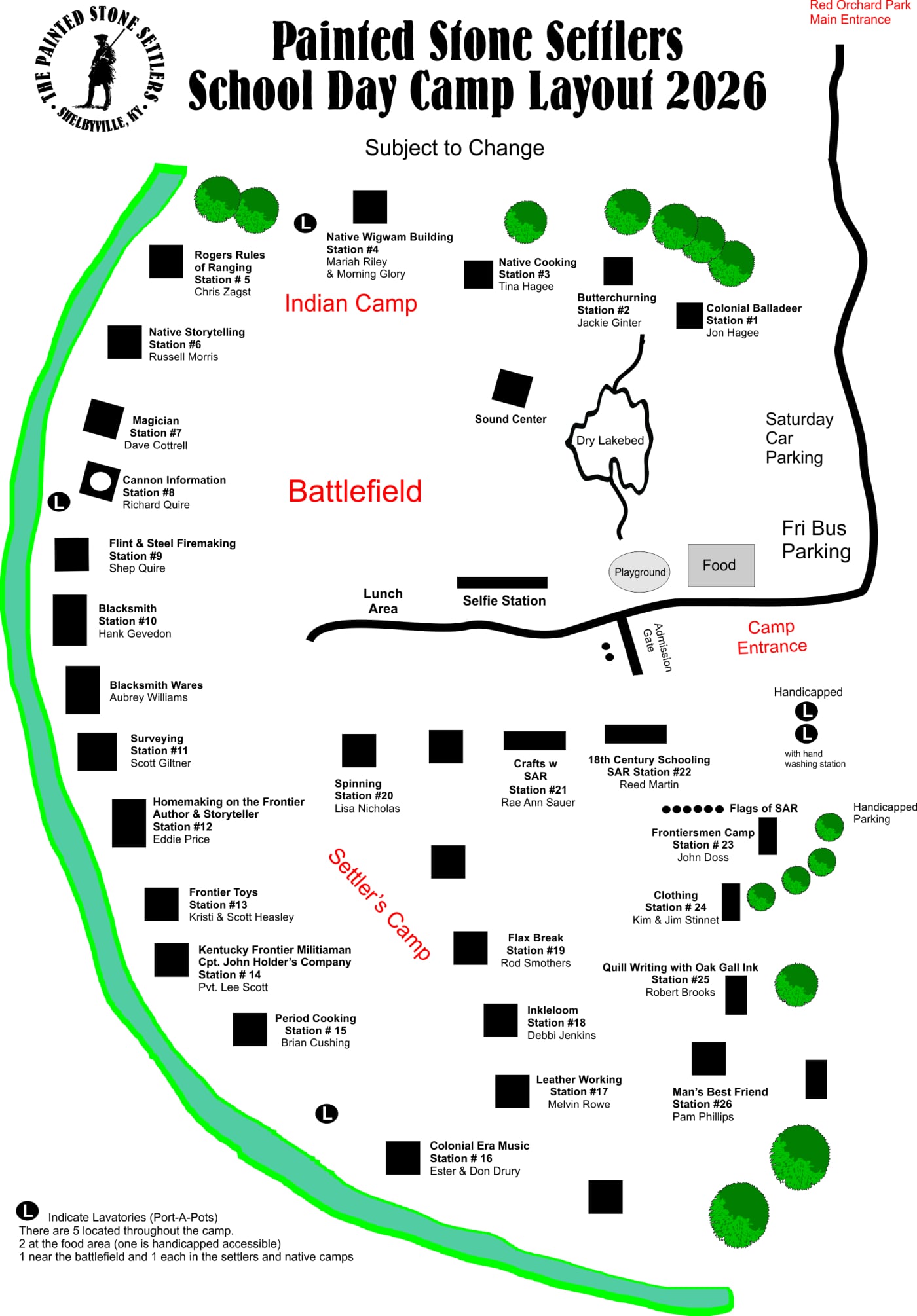
Students will have approximately 10-15 minutes at each station. These 10-15 minutes includes travel time to the next station. All stations are broken down into categories based on the following topics: Survival Skills, Home & Hearth Skills, Entertainment and Native Ways. Time has been built into your schedule to have a lunch break and bathroom breaks – several Port-A-Johns are placed throughout the encampment and at the front entrance along with a hand-washing station.
Section #1: SURVIVAL SKILLS:
The stations that fall under this category depict many of the skills employed by frontiersmen. Many times settlers were farmers during crop growing seasons, and would take to the woods after harvesting their crops to produce additional income by trapping. Often they would be gone for months or even years on hunting or scouting expeditions, thus earning the name Longhunters. Kentucky provided prime hunting grounds for this type of occupation. Our re-enactors practice the skills and dress as their 18th century counter-parts would have done.
SECTION #2: HOME & HEARTH:
These basic skills were common to every family on the frontier to keep a household running smoothly. Oftentimes skills were gender specific – children learned the same tasks as their father or mother. Children might have the opportunity to earn a living practicing these skills once they matured. These stations provide a greater insight into the colonial way of living and daily routine experienced by the settlers.
SECTION #3: ENTERTAINMENT:
Entertainment, or leisure time in general, was scarce on the frontier. We have provided you with an overview of colonial era entertainment to give you a taste of 18th century arts and humanities. Entertainment was usually in the form of singing or playing a musical instrument on the frontier. This was a simple way to convey ideas not written down, a creative form of storytelling. Annual colonial “Trade Faires” were a common site throughout the 18th century in larger towns east of Kentucky. A carnival-like atmosphere would often accompany these faires.
SECTION #4: NATIVE WAYS (NATIVE AMERICAN CAMPSITE):
Native American re-enactors will be on hand to speak to students about the Native American way of life. Students will gain a better understanding of how settlers often relied on the Native American society to survive. Tribes in Kentucky in the 18th Century were referred to as Eastern Woodland Indians, primarily a mixture of Shawnee, Mohawk and Iroquois. These tribes lived in the eastern part of the United States. As forest dwellers, they lived and learned from the land. Even though settlers and Native Americans clashed at this time, in previous centuries in America (Jamestown) settlers had learned valuable ideas and adopted ways of doing things (such as crop planting) from the Native American culture that helped them to survive.
The Stations
Station 1: Songs of the Frontier. Colonial Balladeer Jonathan Hagee will demonstrate the value of music in the 1700’s, long before radio, Alexa and iTunes were invented. Songs were not merely pleasant to the ear, but also used as a method of handing down traditions, recording history and a creative means of storytelling. These ballads and pub songs traveled from Scotland and England made their way into Northern Ireland, finally ending up in the American Colonies. They then accompanied settlers making their way across the Appalachian Mountains into Kentucky.
Station 2: Butter Churning: Watch as re-enactor Jackie Ginter shows you how to make butter the 18th century way. Butter churning was a common chore which often fell to the women or children. After the cow(s) were milked, the milk was left to settle in a cool place, so the cream would rise to the top. The cream was skimmed off and ready for the churn. Once it turned into butter it could be put in molds to shape. Churns and molds were often wooden.
Station 3: Native Cooking - Foodways and Practices. Re-enactor Tina Hagee will demonstrate what types of food Native Americans ate and how they prepared it. Over time, Kentucky settlers incorporated many Native American staples into their diet such as: “The Three Sisters” (corn, beans and squash), natural fruits and berries, and hunted game such as deer and buffalo. They also preserved meat in the form of jerky and pemmican.
Station 4: Native Wigwam Building. Native American re-enactors Mariah Riley and Morning Glory will instruct students how tribes such as the Shawnee, who lived in the Ohio River Valley, used wigwams as their primary form of temporary shelter. They were often made from birchbark and covered with mats, providing a functional living space. Wigwams were utilized during the hunting season and perfect for semi-nomadic lifestyles, allowing tribes to adapt to the changing seasons and use the natural resources of their environment for shelter. DUE TO A FAMILY EMERGENCY - THIS STATION MAY BE UNAVAILABLE.
Station 5: Roger’s Rules of Ranging. With Re-enactor Chris Zagst - Major Robert Rogers’ Rules of Ranging were a set of wilderness combat and scouting guidelines written in 1759 for his Rangers during the French and Indian War. They emphasized small-unit tactics, mobility, and adaptability in the woods, revolutionizing warfare. Learn about the modern-day application of Maj. Robert Roger’s 19 Rules of Ranging in modern video games, Airsoft, and paintball.
Station 6: Native Storytelling. Enhance your Native knowledge by listening to some Native stories from re-enactor Russell Morris, who portrays a Native American of the Shawnee tribe. Storytelling was a rich oral tradition within the Native culture and a way to keep the important cultural aspects of the tribes alive from one generation to the next. They relied on storytelling as a way to document their history, instead of writing it down. Russell will demonstrate Native storytelling and singing. Note: Russell is of Shawnee descent.
Station 7: Magic Dave. Master magician Jimmy McKnight from Shelby County will astound students will his slight of hand tricks. Magic in the colonial era was a form of street entertainment. In Europe, itinerant performers traveled the countryside as magicians performing cup & ball (colonial game), coin, and card tricks.
Station 8: Cannon Information. Widely used in battle for many eras, this artillery piece was typically made of bronze or iron and used by both Americans and the British. The cannon had basic parts, which you will learn about in this station from re-enactor and SAR member Richard Quire, as well as ammunition used. You will get to see the cannon in action about mid-way through the program. And remember – safety first!
Station 9: Flint & Steel Fire Making. How did you start a fire before matches and lighters? Junior re-enactor Shep Quire and Steve Vest, both SAR members, will skillfully demonstrate a skill known to man since pre-historic times. Necessary in any type of weather and a necessity for any campsite or cabin dwelling, firestarting (without matches) is achieved through a certain technique and diligence.
Station 10: Blacksmithing. A blacksmith was an essential figure on the frontier. Join re-enactor Hank Gevedon as he demonstrates a blacksmith’s skills, and see why this trade benefited many in the community. A blacksmith made agricultural tools for farming (hoes, rakes, and axes), barrel hoops for wooden barrels, and household items such as pothooks, locks and utensils. Some tools employed by a blacksmith were: forge anvil, hammer, tongs, vise and file. NOTE: Beware of any fire at this station and do not get too close.
Station 11: Surveying. SAR member Scott Giltner will show how colonial surveyors provided accurate descriptions that enabled the government to grant land to settlers moving westward. As the American colonies grew and settlers claimed more land, the need for land surveyors increased. Many famous men in American history - John Henry (father of Patrick Henry), Peter Jefferson (father of Thomas Jefferson), and George Washington - at one point in their life were employed as surveyors. This presentation explains what a land surveyor in colonial America would have done and the hardships they many times encountered. Reproductions of various types of 18th century surveying equipment and tools are presented and their usage explained, as well as units of measurements. A demonstration of running a chain, with assistance from the students, is included in the presentation.
Station 12: Homemaking on the Frontier. Re-enactor and author Eddie Price will take students back in time to experience homemaking on the Kentucky frontier “from the ground up.” After clearing timber from the land, fencing off pastures, and planting crops, homemakers involved themselves in every aspect of building a home from whatever materials were available. Learn how frontier folk cultivated and preserved their food, made their clothes, doctored their families, and still found time for recreation and religion.
Station 13: Frontier Toys. Re-enactors Kristi and Scott Heasley will demonstrate toys of the time period. With no modern conveniences, toys were often hand-made, many times of wood. The Game of Graces was a popular game enjoyed by children, if they were lucky enough to find spare time to play it when not doing chores. Dolls, miniature soldiers, dice and checkers were also games enjoyed by children.
Station 14: Kentucky Frontier Militia: The frontier militia was very important and had a decisive role in Kentucky becoming a state and opening up this territory for settlement. Kentucky’s state militia, under federal law, enrolled every able-bodied male citizen age 18 – 45 to secure the area from British and Native American control. Learn about the life of a militiaman from re-enactor Pvt. Lee Scott. Squire Boone was in command of a group of militiamen at Painted Stone Station.
Station 15: Cooking. In the 18th century, American cooking was shaped by geography, seasonality, and available resources. Re-enactor Brian Cushing will give you a real taste of history by demonstrating cooking methods of the 18th Century using recipes from the period. You’ll discover what people ate during the American Revolutionary War period of history.
Station 16: Colonial Era Musical Instruments. Re-enactors Don and Esther Drewery will be demonstrating Colonial Era music on period instruments such as the hammered dulcimer, Appalachian dulcimer, psaltery, bowed psaltery, and Celtic harp. Early settlers may have brought such instruments to the frontier with them and the result became a mix of the cultures. They would have used music for religion, entertainment and military purposes.
Station 17: CANCELED Leather Working. SAR member Melvin Rowe will demonstrate the craftsmanship that goes into making leather goods. People in this trade included tanners, shoemakers, coach makers, breeches makers (men of the frontier wore leather leggings), bookbinders and upholsterers. Leather was used to make a variety of products such as gloves, harnesses and saddles, shoes, possible bags and equipment used by soldiers (cartridge boxes). Leather workers were also kept busy with repair work.
Station 18: Inkle loom. Re-enactor Debbie Jenkins Bales will demonstrate her handiwork on the inkle loom, a period tool for producing strips/bands of hand-woven warp-faced cloth. These decorative strips were used for belts, bag handles, headbands or straps to tie items together. When sewn together, the strips could be turned into bags.
Station 19: Flax. Oldham County re-enactor and SAR (Sons of the American Revolution) member Rod Smothers will demonstrate the necessary 18th century commodity of flax. Early colonists grew flax for the production of fabric (linen clothing), twine and rope. The Puritans introduced flax to North America, a fiber that dates back to the time of ancient Egypt.
Station 20: Spinning. Re-enactor Lisa Nicholas will demonstrate spinning. During the American Revolution, when Americans could not acquire goods from England, weaving and spinning became a necessity. The spinning wheel is a device for spinning thread or yarn from natural or synthetic fibers, which are then turned into clothing. Since every piece of clothing had to be made by hand and spinning was often a household chore learned as a child.
Station 21: Crafts with the SAR. Members of the Governor Isaac Shelby Chapter of the SAR (Sons of the American Revolution) honor our Revolutionary War patriot ancestors by promoting patriotism, serving our communities and educating and inspiring future generations about the founding principles of our country. Join their Outreach Education‘s Rae Ann Sauer and others to make a craft relevant to the 18th century time period.
Station 22: 18th Century Schooling. Re-enactor and SAR member Reed Martin will show how important the art of learning was and stress that it was to be taken very seriously. You’ll learn about the nature of schools, schoolmasters, and period educational materials. It was considered a mark of intelligence and good social standing for one to write beautifully and legibly. Practice, practice, practice is what it took to have good penmanship and to write those long documents, like the Declaration of Independence, and sign them with your “John Hancock.” The more you knew, the more you could do to better your station in life.
Station 23: Frontiersman Camp: Re-enactor and SAR member John Doss will display different accouterments that a common frontiersman, or longhunter, might carry with him, explaining the purpose of clothing and equipment. Men such as Daniel Boone and his brother Squire were typical frontiersmen, many times called to perform many duties: they trapped, hunted, explored, were surveyors and law makers, part of the milita, and performed many other duties. Many frontiersmen accompanied Squire Boone to Painted Stone Station and were involved in the Long Run Massacre.
Station 24: Clothing. Re-enactors Kim and Jim Stinnet will give you a run-down of clothing and how many settlers adapted their clothing to the frontier life. Clothing needed to be functional and utilitarian. Proximity to other colonies and trade routes affected getting the necessary supplies (pins, scissors, etc.). You had to make your own clothing – cloth and all – and settlers adapted what they wore for daily survival. Clothing had to be durable and mendable.
Station 25: Quill Writing with Oak Gall Ink. Let SAR member Robert Brooks show you how the colonials wrote a letter, documents, kept a journal, etc. He will demonstrate how a turkey feather can be carved into a quill and how Oak Gall Ink was made and what purpose it served. This special ink has been made since the time of Egyptian Pharaohs through the writing of our American Founding Documents. He will have on display quill and calligraphy items, as good penmanship was an exquisite art form.
Station 26: Man’s Best Friend. Tracing their roots back to Germany, Plott hounds were brought to the colonies by Johannes Georg Plott in 1750. Known as working hunting dogs, they had been conditioned over the years to track big game and became valued for their stamina, scenting ability, and adaptability to mountain terrain. They were an important part of the Great Migration of Europeans to America. Painted Stone Settlers’ member Pam Phillips will relate their history.
Concessions Area. Located near the camp entrance/at top of the hill.
Selfie Station: Let your students get a photo while dressed in t8th century clothing.
ADDRESS
P. O. Box 1381
Shelbyville, KY 40066
CONTACTS
Email: info@ paintedstonesettlers.org